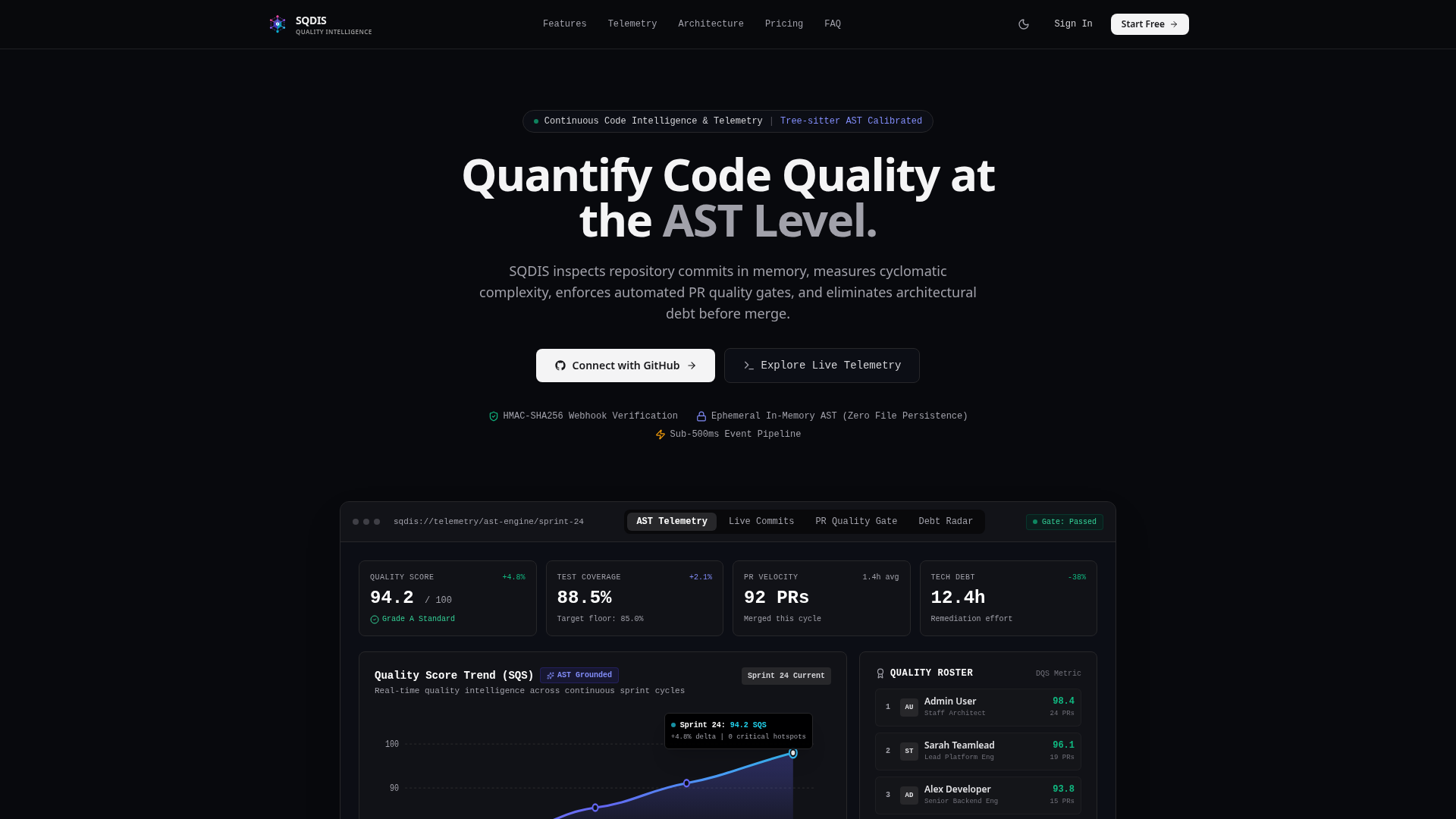
Software Quality and Developer Intelligence System (SQDIS)
SQDIS is an enterprise-grade developer analytics, code quality intelligence, and automated deployment safety platform. It connects static compiler analysis, statistical machine learning models, and real-time production telemetry to create a completely closed-loop engineering feedback lifecycle—from pull request creation to production canary deployment and automated rollback.
Service architecture topology and data pipeline flow.
Automated Pull Request Quality Gate & Review Bot
Integrates with GitHub webhooks to inspect pull requests against configurable quality thresholds, automatically blocking risky merges through branch protection rules.
Code Intelligence and Hotspot Treemap
Uses compiler-level AST parsing to measure code complexity, detect duplicates, and highlight high-risk files on an interactive Churn versus Complexity treemap.
Test Impact Analysis
Traverses code dependency graphs during pull requests to run only the tests affected by changed files, reducing CI suite execution times by up to 95 percent.
Developer and Team Performance Analytics
Applies machine learning models with explainable attribution to calculate quality scores, track DORA delivery metrics, and identify project Bus Factor risks.
Polyglot Event-Driven Architecture
Separates business orchestration in a NestJS gateway from computational AST and ML workloads in a FastAPI engine, synchronizing live updates to clients through Redis Pub/Sub and WebSockets.
Sub-Linear Clone Detection with MinHash and LSH
Replaces expensive quadratic AST comparisons with 4-gram token shingling and Locality-Sensitive Hashing to detect semantic code duplicates across repositories in O(N) time.
Dependency Graph Transposition for Test Impact Analysis
Constructs an in-memory repository dependency graph, transposes the edges, and traverses reachable nodes with Breadth-First Search to prune unaffected CI test suites by up to 95 percent.
Managing multiple repositories in a single UI caused cross-codebase state leakage, while calculating naive arithmetic averages distorted health metrics by blending zero percent uninstrumented repositories with high-coverage services.
Bound repository context strictly to URL query parameters and replaced arithmetic averages with a categorized portfolio grid, preventing state collisions and clearly distinguishing onboarding codebases from failing suites.
Pairwise AST comparisons created an O(N^2) computational bottleneck for code duplicate detection, while executing full test suites on every pull request introduced severe CI pipeline delays.
Implemented MinHash token shingling with Locality-Sensitive Hashing for sub-linear O(N) duplicate detection, paired with graph-based Test Impact Analysis to isolate and run only tests affected by changed files.
Evaluating developer contributions using black-box machine learning created risks of opaque ratings, unfair conclusions, and privacy leaks across peer teams.
Integrated SHAP feature attribution to expose the exact metric drivers behind each score, while enforcing server-side RBAC privacy gates so contributors can only view their own score details.
Local Reproduction (1 Command)
Clone the repository and boot the full environment (services, datastore, metrics) via Docker Compose: